Learn2Learn
A four-phase method for learning anything, built around a normal school week — written for children making the jump from primary to secondary school in Ireland, and the parents who want to help without adding pressure.
Key Features & Outcomes
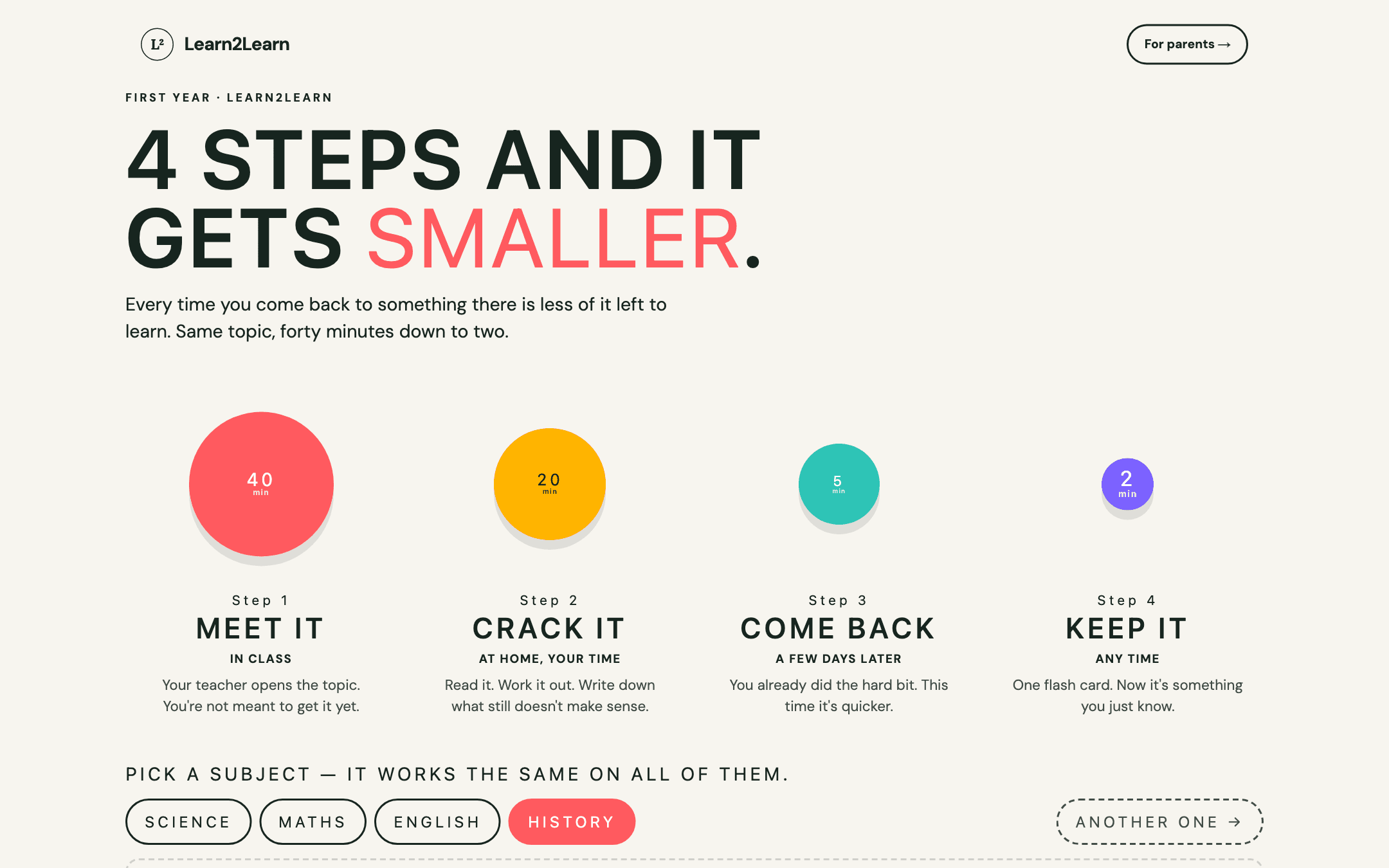
- Two linked pages for two different readers, not one page averaged between them — a kid-facing view with shrinking minutes and a switchable worked example, and a parent-facing explanation of where the method came from
- Built on one idea a twelve-year-old can hold onto - the more familiar a topic gets, the smaller it gets, measured in minutes (40 down to 2) rather than left as a feeling
- A pool of twelve worked examples across four subjects, one shown at random, because making an example "generic" by abstracting it would have thrown away the concreteness that made it work
- Gives the loop back to the classroom its own section, because asking a question in a new school is the hardest and most durable part of the method
- Content-led site where the tests assert what each page says, not how it renders
- Migrated off an AI site builder onto Cloudflare with every trace of the original hosting platform removed
The idea
Starting secondary school asks a lot of a child: more teachers, more subjects, more homework, more expected of them. The skill underneath all of it — how to actually learn something — is almost never taught directly.
Learn2Learn came out of a conversation before my daughter's first year. The deal was that all I wanted from that year was for her to learn how to learn. Not top marks. Just get hold of that one idea. It took the pressure off, and it worked. My son starts now, so it is written down.
The method
Four phases that fit around a normal school week:
- Introduction — in class. You are meeting the topic, not understanding it yet.
- Learn — at home, in your own time. Read it, make sense of it, write down the questions you still have. This is the phase that matters and the one allowed to take longest.
- Revise — come back to what you worked out, rather than reading it cold again.
- Revise the revision — flash cards, ten minutes across subjects, building a store of things you can reach for.
Underneath all four: the more familiar it gets, the smaller it gets. A topic that filled an evening in September is a five-minute review by Christmas. Not because the child worked harder — because it shrank.
Phase two loops back to phase one. Working through something at home often sends you back to the classroom with a question, and asking it is the hardest part for a child three weeks into a new school. It is also the part that lasts longest.
The build
The first version was generated by an AI site builder from the idea alone, and it invented its own framework — four abstract pillars nobody had decided on, written confidently enough to pass for the real thing. Replacing that with the actual method was the first job; the design and hosting were fine.
The second correction came after the content was already right. The page read
as well-made and mis-aimed — a parent's voice, opening with "starting
secondary school asks a lot of a young person," which a twelve-year-old closes
before reaching the method. The fix wasn't rewriting; it was recognising two
different readers were being served one averaged page. The site is now two
pages that link to each other: / for the child, /for-parents for the
explanation, kid first because a parent will click through and a child will
not scroll past one.
It runs on Cloudflare Workers under 1zero9.com, with every trace of the original AI-builder platform removed — its hosting config, an auth module that only worked behind that platform's headers, and a build plugin that existed to serve it.
The site is content-led, so the tests assert the content on each page separately: the four steps in order, the minutes that make "it gets smaller" a checkable claim, the line the method rests on, the statement that this is unaffiliated with any school or exam board, and a guard that the invented pillars cannot creep back.
Why it matters
There is no qualification behind this and no institution attached, and the site says so plainly. That honesty is the point: it is one parent's observations, written down in case they are useful to somebody else's child.