F1
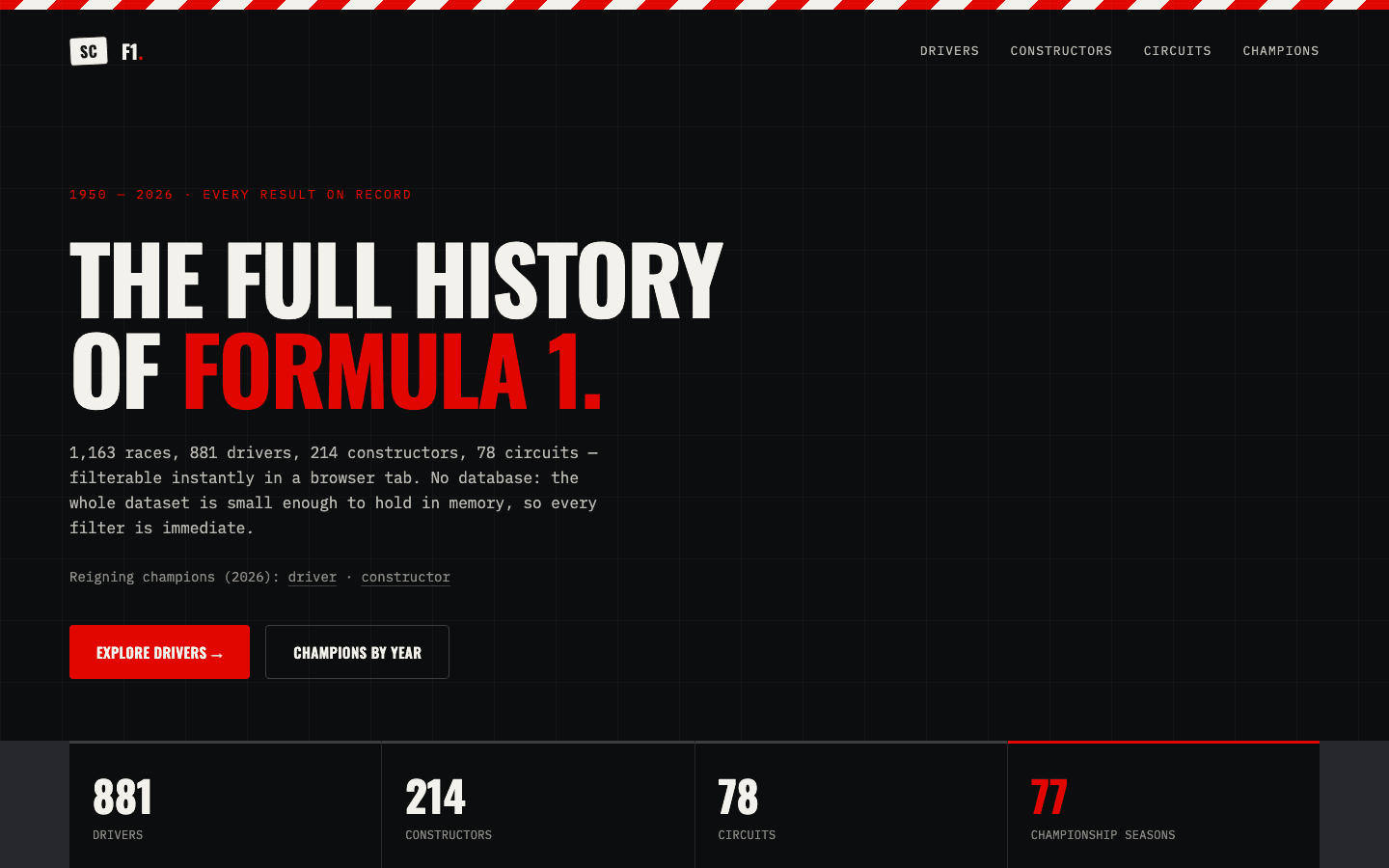
The full history of Formula 1, 1950 to now — every driver, team, circuit and season, filterable instantly with no database, because the whole dataset is small enough to hold in a browser tab.
Key Features & Outcomes
- No database: 26,181 real result rows fetched once at build time and filtered entirely client-side — genuinely faster than a DB round-trip at this scale, verified with the real row count rather than assumed
- Real cross-slicing, not just search and sort — filter drivers by the actual team they raced for (built from race results, not a driver's listed nationality), constructors by nationality, circuits by country, all with a champions-only toggle
- A personal layer alongside the historical one — races actually attended in person (Monza 2004, Barcelona 2005) marked on their own pages
- Visual identity built from the real thing — the track kerb's red/white stripe and the actual marshal's "SC" board photographed at a Grand Prix, not an invented logo or a stock photo
- Found and fixed a genuine production incident after shipping — Cloudflare was silently falling back to full server-rendering on every request because no incremental-cache backend was configured, which only breaks under real concurrent traffic; reproduced it directly with a load test, fixed it, verified with the same test clean afterward
The idea
Watching every Grand Prix since Monaco 1996 builds up a lot of half-remembered history — who drove for whom, which circuits came and went, which season a particular result belongs to. The idea was a personal reference for all of it: every result on record, sliceable however curiosity points.
The build
The Jolpica API (the open successor to the now-retired Ergast API) covers
every season since 1950. Pulling it in reliably took three attempts — a naive
retry loop died on a sustained rate limit, a better-paced version still
crashed on a plain network exception because HTTP-status retry logic never
catches fetch() throwing outright, and the fix that finally held pairs
sensible pacing with a separate handler for network-level failures. That
whole shape is now a reusable pattern rather than something the next project
has to re-learn the hard way.
The dataset itself — 1,163 races, 881 drivers, 214 constructors, 78 circuits — is small enough to ship as static JSON and filter in memory, so there's no database and no request-time API call anywhere in the app.
Shipping it surfaced a second real lesson: the app looked fine right after deploying, then started failing under real concurrent traffic. Cloudflare's OpenNext adapter needs its own incremental-cache backend configured or it silently re-renders every page from scratch on every request — invisible in a quiet test, expensive enough under load to hit Cloudflare's CPU limit. Load testing the live site (not just the deploy log) is what actually caught it.
Why it matters
Twenty-nine years of watching this sport, and two races seen in person, now have a proper home — one built to be trustworthy about the numbers first, with the branding held back until the shape of the thing had actually proven itself.