LaunchCity
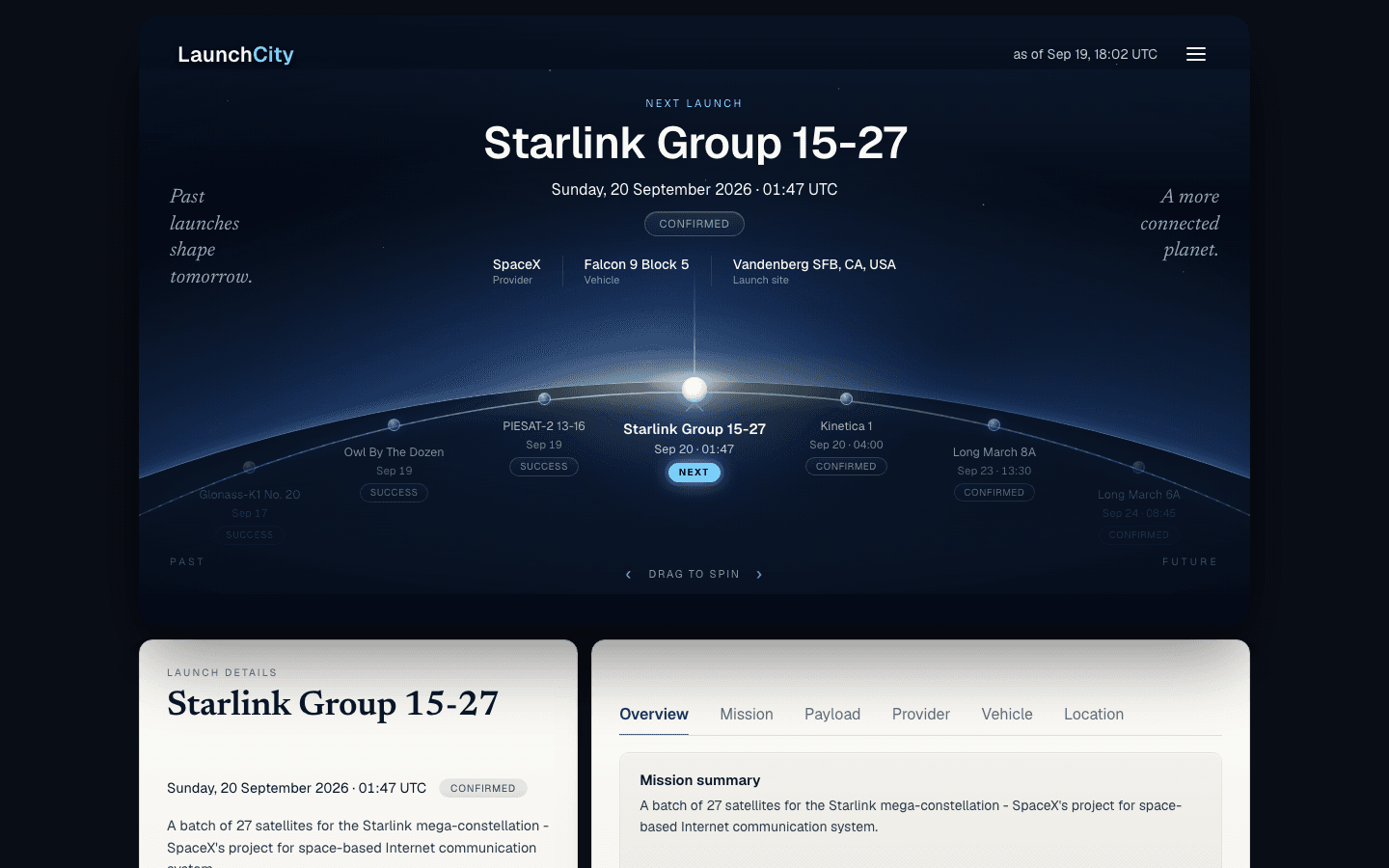
A public tracker for space launches worldwide — what's launching, when, by whom, on what vehicle, from where, and why — pulled from Launch Library 2 and cached at the edge.
Key Features & Outcomes
- Every upcoming and past launch worldwide — provider, vehicle, launch site, payload, mission purpose and current status, not just a countdown
- Ingestion runs from GitHub Actions, not the Worker itself: Launch Library 2 rate-limits per source IP, and Cloudflare Workers share outbound egress, so a request from this Worker's own cron could get throttled while the identical request from a GitHub runner succeeds
- The cache is deliberately disposable — Workers KV, rebuildable from the source API at any time, never treated as the historical record of truth
- Found and fixed the same production incident F1 later hit independently — Cloudflare silently falling back to full server-rendering with no incremental-cache backend configured, invisible until real concurrent traffic finds it
The idea
Launch schedules are scattered across provider press pages, agency sites and enthusiast trackers that each cover a slice of the picture. LaunchCity pulls it into one place: what's launching, who's responsible, what it's carrying, and why — for any launch, from any organisation, not just the ones with the biggest marketing budget.
The build
Launch Library 2 is the data source, cached in Workers KV rather than queried live on every request. The interesting decision wasn't the caching — it was where the refresh runs from. Launch Library 2 rate-limits by source IP, and Cloudflare Workers share outbound egress with every other Worker on the platform, so a refresh request from this Worker's own cron could get throttled by traffic that has nothing to do with it. The fix was moving ingestion to GitHub Actions, which originates from a different IP entirely — confirmed directly: the same request that got a 429 from Cloudflare's egress returned 200 from a GitHub runner eleven minutes later. The Worker still serves the site and reads the same KV cache; only the writer moved.
The cache itself is explicitly disposable — a rebuildable projection of the source API, never the canonical record — so a bad refresh or an expired entry is a non-event, not a data-loss risk.
Later, building F1 independently surfaced a real production incident — Cloudflare's OpenNext adapter needs its own incremental-cache backend configured, or every request silently falls back to a full server render, which only breaks under real concurrent traffic. LaunchCity had the same gap, found and fixed the same day once the pattern was known.
Why it matters
A genuinely public reference — no login, no paywall — for a question that's usually only answered well if you already know which company or agency to look for.